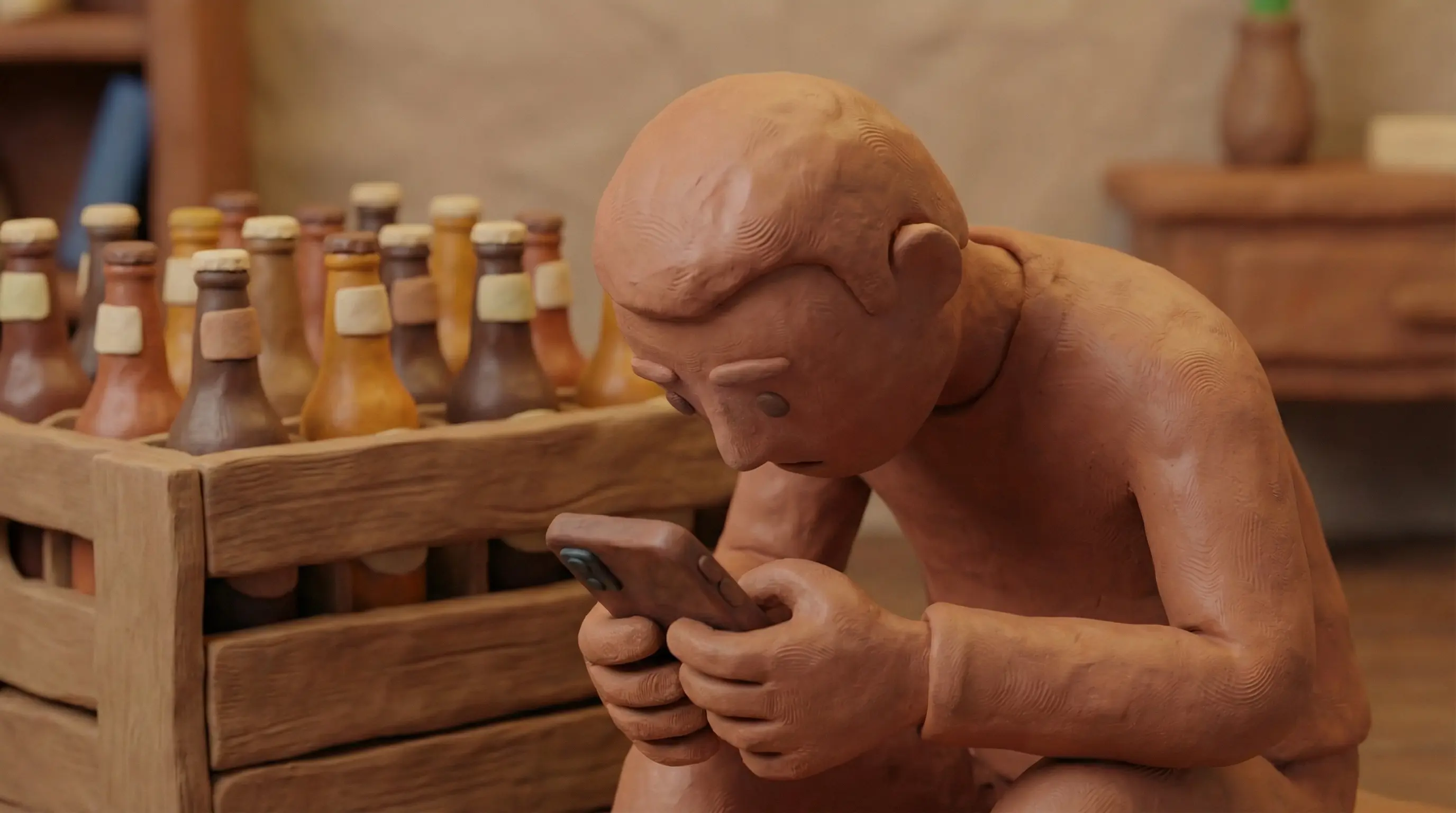
You quit drinking. You went to meetings. You did the work. And for a while, it felt amazing—until you realized you weren’t actually free. You’d just switched addictions.
Maybe you’re checking your phone 200 times a day instead of drinking. Maybe you’re doomscrolling for hours instead of using substances. Maybe you’ve replaced one dopamine hit with another, slightly more socially acceptable one.
On the surface, it looks like progress. Underneath, the same mechanism is running your life.
Why Your Brain Does This
Addiction isn’t really about the substance or behavior. It’s about the reward mechanism underneath.
When you quit alcohol, your brain doesn’t magically stop craving dopamine or relief. It just starts looking for a new way to get it.
Social media, gambling, shopping, eating, work obsession, even exercise—anything that reliably triggers dopamine and emotional escape can become your new drug of choice.
This is why recovery that focuses only on abstaining from the original substance often fails in the long term:
- You remove the alcohol, but not the pattern.
- You stop drinking, but don’t learn to sit with anxiety, shame, boredom, or loneliness.
- You create a dopamine vacuum your brain is desperate to fill.
Research consistently shows that a large percentage of people in recovery from substance abuse struggle with behavioral addictions or replacement addictions. The brain has learned that seeking external stimulation is how to feel okay. That lesson doesn’t disappear just because you stopped drinking.
How to Identify Your Replacement Addiction
The tricky thing about replacement addictions is that they’re often normalized or even celebrated.
Nobody thinks scrolling social media for three hours is as bad as drinking a bottle of vodka. Working late is praised. Exercising daily is “healthy.” Shopping is framed as self-care.
But internally, the mechanism can be almost identical.
| Original Addiction | Common Replacement Addictions | Red Flag Signs | Why It’s Appealing |
|---|---|---|---|
| Alcohol | Social media scrolling | Checking phone first thing in the morning, feeling anxious when away from phone, using it to numb feelings | Instant gratification, socially acceptable, no legal consequences |
| Alcohol/Drugs | Gambling | Finding reasons to gamble despite losses, hiding betting behavior, using it to escape stress | High stakes = high dopamine, similar risk-seeking mechanism |
| Alcohol/Drugs | Compulsive shopping | Buying things you don’t need, relief followed by guilt, hiding purchases or deleting order emails | Shopping high wears off quickly, leading to repeated buying |
| Any substance | Work obsession | Working evenings/weekends, using work to avoid feelings, identity entirely tied to productivity | “Productive” dopamine, socially rewarded, feels purposeful |
| Any substance | Exercise addiction | Exercising through injury, panic at the idea of skipping a day, using workouts to punish yourself | Endorphin rush, sense of control, hard to criticize from outside |
Ask yourself:
- Do I use this behavior to avoid feelings?
- Do I do it compulsively, even when I said I wouldn’t?
- Do I feel anxious, restless, or irritable when I can’t do it?
- Do I lie to myself or others about how much I’m doing it?
If you answered “yes” to three or more, you’re probably not just “into” something—you may have a replacement addiction.
The Real Problem with Replacement Addictions
Replacement addictions are dangerous precisely because they’re subtle.
- They develop gradually, so you don’t notice the slope.
- They are often socially rewarded (“at least you’re not drinking anymore”).
- They give you just enough relief that you don’t question them deeply.
While you’re swapping one addiction for another, something critical is not happening:
- You’re not learning how to sit with difficult emotions.
- You’re not building healthy coping mechanisms.
- You’re not creating a life that feels genuinely meaningful and worth inhabiting.
You’re just shuffling the deck chairs on the Titanic. The ship is still pointed at the iceberg.
The Three-Part Recovery from Replacement Addiction
Escaping the addiction replacement trap requires more than just quitting the new behavior. It requires changing the way you relate to discomfort, reward, and your own life.
Step 1: Recognition
This is much harder than it sounds because your brain has a vested interest in not seeing the problem.
To recognize a replacement addiction, be brutally honest:
- When do I reach for this behavior? (Bored, angry, lonely, stressed, ashamed?)
- What would I feel if I couldn’t do it for a week?
- If someone I loved behaved this way, would I be worried?
Don’t rationalize it as “just how I unwind.” Name it for what it is: another way to avoid being with yourself.
Step 2: Address the Underlying Need
This is where most people fail.
They quit the original addiction.
They spot the replacement addiction.
Then they try to quit that too—leaving themselves with nothing.
Meanwhile, the original problem—the emotional pain, anxiety, emptiness, or shame—remains completely untouched.
You cannot simply subtract addictions. You have to add healthier ways to meet the same needs:
- If alcohol used to manage anxiety, you need actual anxiety tools: therapy, breathwork, nervous-system regulation, movement, nutrition, sleep, boundaries.
- If social media fills a connection gap, you need real connection: in-person conversations, phone calls, community, support groups, shared activities.
- If work or exercise gives you a sense of worth, you need a deeper identity that isn’t tied solely to output or performance.
Ask: What was the original job this addiction was hired to do?
Then: How can I meet that need in a way that doesn’t destroy me?
Step 3: Build a Life Worth Being Present In
This is the hardest and most important step.
The deepest reason replacement addictions exist is simple: being present in your life doesn’t feel good yet.
Too much:
- Pain
- Boredom
- Emptiness
- Chaos
So you escape. Over and over.
Recovery means slowly building a life that is:
- Structured enough that you don’t feel lost all the time.
- Challenging enough that you feel growth instead of stagnation.
- Connected enough that you feel seen and supported.
- Meaningful enough that you don’t need constant escape.
This can look like:
- Establishing non-negotiable basics: sleep, meals, movement, and daily routines.
- Exploring hobbies that genuinely interest you, not just distract you.
- Investing in a few real relationships instead of hundreds of shallow digital ones.
- Choosing work (or a path toward work) that doesn’t feel like pure soul extraction.
None of this is instant. But it’s the only way to make sobriety feel like freedom, not like punishment.
The Uncomfortable Truth
Addiction recovery isn’t about superhuman willpower. It’s about replacing an empty, painful, or chaotic life with one that’s actually livable.
You can’t white-knuckle your way out of replacement addiction, because the addiction is currently solving a problem for you:
- It numbs pain.
- It fills emptiness.
- It creates excitement where there is none.
The solution isn’t a more acceptable addiction.
The solution is a different life.
That takes real work: honesty, support, new skills, and time. But on the other side of that work is something every addiction promises and never delivers—actual peace.
You don’t just deserve to be sober from alcohol. You deserve to be free from the entire loop of needing something outside of you just to feel okay.